If Javascript is single-threaded, how can ‘await’ wait ?
The Illusion of Waiting
When developers first see await, it feels like Javascript is waiting for a result.
BUT IS IT ?
Lets look at following code :
function fetchData() {
	return new Promise.resolve('some data');
}

async function doo() {
	const data = await fetchData();
	console.log(data);
	//rest of code
}
console.log('before doo() call');
doo();
console.log('after doo() return');
Lets focus inside doo() function
...
async function doo(){
  const data = await fetchData();
  console.log(data);
  //rest of code
}
...
- code looks synchronous, it appears as if the program pauses at
awaituntil the data arrives - But Javascript is single threaded, and if it truly waited, the entire application would freeze, the UI would stop responding.
Confusing right ? Does Javascript waits or not ?
The Reality: JavaScript Is Not Waiting
‘await’ pauses the function, not the thread.
- The code after
awaitbecomes amicrotask, - that runs whenever the
Promiseis resolved.
Lets run the above code line by line:
-
Synchronous code starts :
console.log('before doo() call')
Prints :before doo() call -
Calls doo() : Thread is still executing synchronously,
It hitsawait fetchData();The remaining code afterawaitis scheduled as amicrotask.
As a result the function pauses, it syncronously returns to the caller. -
Continue after the call
console.log('after doo() return')
Prints : after doo() return -
Call stack empties, microtasks run :
Call stack becomes empty.
The Event Loop processes the microtask queue where remaining portion ofdoo()is ready to be executed.console.log(data);
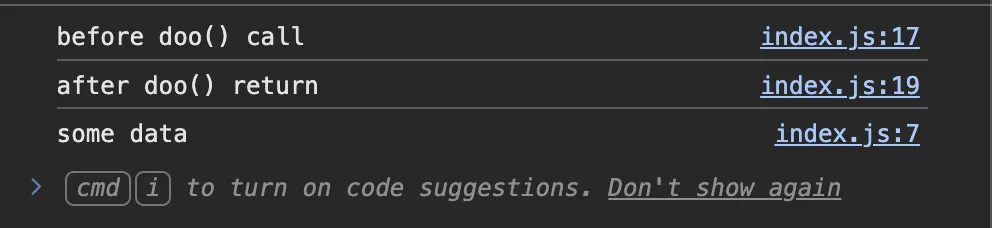
Prints :some data
Output :
Think of it like this : await transforms the function into:
function doo(){
 fetchData().then((data) => {
  console.log(data)
  // rest of code
 })
}
Of course, this transformation is only a mental model, not the exact implementation.
But it explains the core idea clearly.
await basically, “splits the function into two parts”
Before await → run now
After await → run later (microtask)
Mental Model: Bookmarking a Chapter
Think of a function as a chapter in a book.
When JavaScript reaches await in a chapter
- it places a bookmark in the chapter
- leaves the chapter for now
- continues reading other chapters (running other code)
- comes back to the bookmarked page when the Promise resolves
‘await’ doesn’t stop the reader (the JavaScript thread).
It just bookmarks the chapter and resumes it later.
References
- https://33jsconcepts.com/concepts/async-await#async-await
- https://developer.mozilla.org/en-US/docs/Web/JavaScript/Reference/Statements/async_function
Author’s Notes
I enjoy breaking down complex Javascript and algorithms into simple mental models.
If you found this useful, feel free to connect or share your thoughts by connecting with me on linkedin